










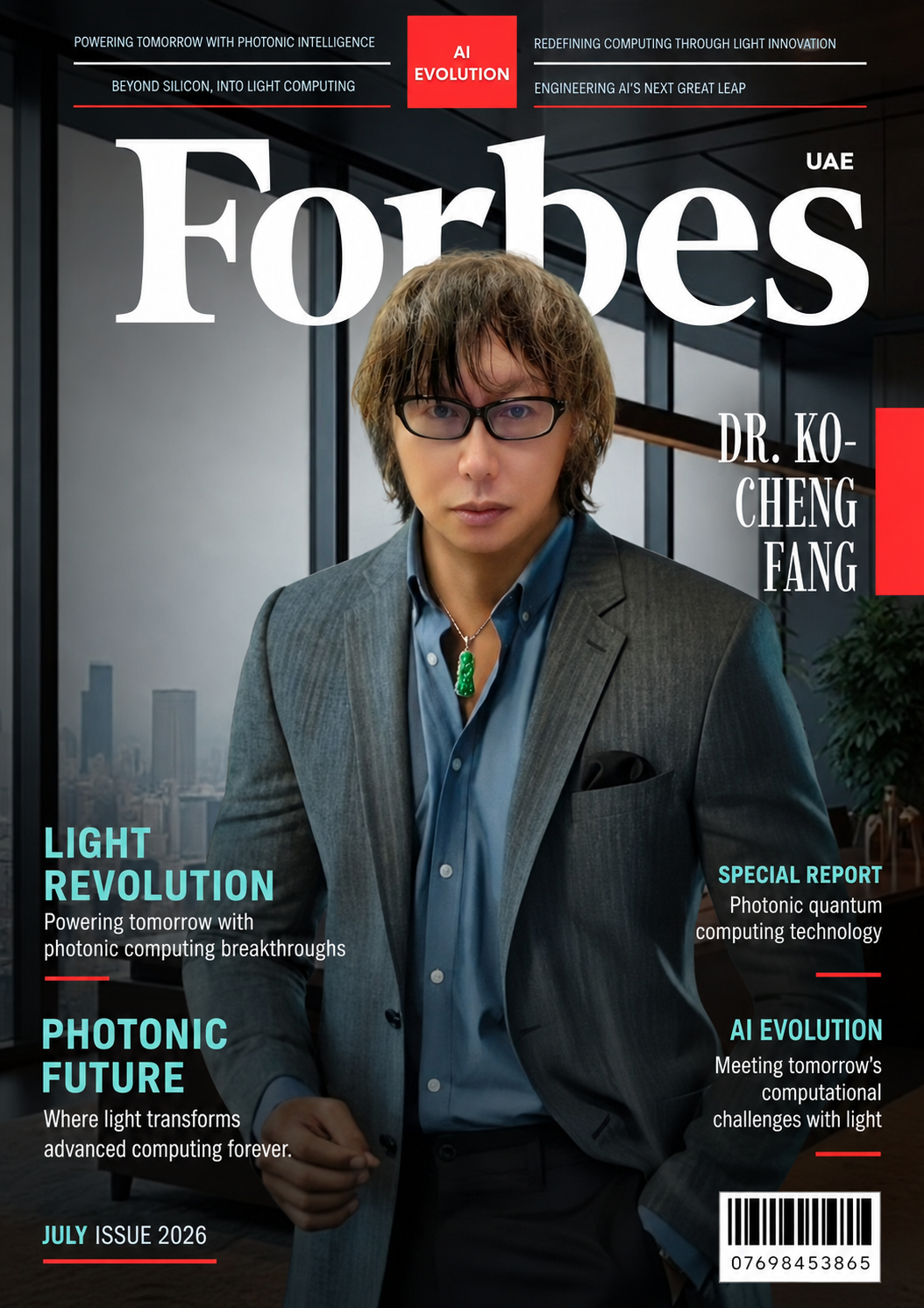
The global technology industry is entering a pivotal new phase as artificial intelligence, cloud computing, and high-performance data processing place unprecedented demands on today’s semiconductor infrastructure. While silicon-based chips have powered decades of digital innovation, researchers and technology leaders increasingly recognize that conventional electronic architectures face mounting limitations in speed, energy efficiency, and scalability. Against this backdrop, LongServing Technology Co., Ltd. has announced a series of strategic initiatives designed to position the company at the forefront of the emerging photonic computing revolution.
Founded by renowned inventor, entrepreneur, and semiconductor innovator Dr. Ko-Cheng Fang, LongServing Technology has officially launched its Global Series A Strategic Financing Round, establishing a current enterprise valuation of $2.5 billion. Through the offering of up to 20% minority equity, the company aims to secure $500 million in strategic investment to accelerate research and development, expand semiconductor manufacturing capabilities, and construct international production facilities for its flagship 2nm Multi-Bit Optical Quantum Chip.
The financing initiative represents one of the company’s most significant milestones to date. According to LongServing Technology, discussions have progressed following engagement with sovereign wealth funds in the Middle East, including investors from Dubai and Bahrain, alongside institutional investment groups specializing in technology and intellectual property.
Investing in the Future of Light-Based Computing
Unlike traditional semiconductor companies focused on incremental improvements to silicon technology, LongServing Technology is pursuing an entirely different approach to computing—one built on the power of light.
The company’s long-term vision centers on photonic quantum computing, where photons replace electrons as the primary medium for transmitting and processing information. Because light travels at extraordinary speed while producing significantly less heat than electrical current, photonic computing has long been viewed as one of the most promising frontiers in advanced semiconductor research.
As artificial intelligence models continue growing in complexity, today’s processors consume increasing amounts of electricity while generating substantial heat that requires expensive cooling infrastructure. These challenges have intensified the search for computing technologies capable of delivering dramatically higher performance without proportional increases in energy consumption.
Dr. Ko-Cheng Fang believes photonic architecture represents a practical pathway toward overcoming many of these challenges.
A New Generation of Optical Chip Design
Earlier this year, LongServing Technology unveiled several architectural concepts illustrating its vision for next-generation optical computing. The company introduced a three-dimensional photonic quantum chip framework, an advanced optical transmission network, and a proprietary photonic full-adder design that together outline its research roadmap.
Unlike conventional processors that rely entirely on electrical signals moving through semiconductor pathways, the proposed architecture processes information using photons traveling through carefully engineered optical channels.
The design incorporates a simplified three-layer structure. A dedicated photonic memory layer preserves optical information during computation, while photonic logic gates perform processing operations above it. An upper optical routing network directs light signals efficiently across the chip, creating a streamlined architecture intended to improve scalability and reduce energy loss.
Another distinguishing characteristic is the company’s specialized 45-degree optical routing configuration, developed to optimize light transmission instead of electrical current flow. This approach seeks to improve communication between processing elements while minimizing inefficiencies typically associated with conventional semiconductor designs.
X-Photon: Expanding the Possibilities of Photonic Computing
Supporting the company’s research is another proprietary innovation known as X-Photon.
One of the greatest engineering challenges in optical computing has been the relatively large wavelength of light compared to the microscopic dimensions of modern semiconductor manufacturing. According to LongServing Technology, X-Photon is a photonic quantum material capable of generating light at approximately two nanometers, potentially allowing optical circuits to operate at scales compatible with future advanced chip fabrication.
The company also states that X-Photon materials have demonstrated the ability to achieve precise 90-degree light reflection within microscopic optical channels. If successfully commercialized, this capability could help overcome longstanding technical barriers involving signal routing, chip integration, and optical circuit efficiency.
By maintaining information in an optical state throughout much of the computational process, LongServing Technology aims to reduce the repeated electrical-to-optical conversions that currently consume energy and generate excess heat in many advanced computing systems.
Strengthening Global Intellectual Property Leadership
Alongside its financing announcement, LongServing Technology also introduced a comprehensive global intellectual property commercialization strategy centered on its international patent portfolio.
The company holds patents across multiple major jurisdictions, including the United States, China, Japan, Taiwan, and India. According to LongServing Technology, these patents cover operating system security architectures, multi-factor authentication technologies, biometric verification systems, secure application access controls, and protected data authorization frameworks.
LongServing Technology stated that it has completed historical assessments relating to technologies it believes fall within the scope of its patent portfolio. Backed by institutional litigation funding partners, the company intends to pursue licensing opportunities while enforcing its intellectual property rights where appropriate under applicable laws.
Strategic Partnerships for Long-Term Growth
Rather than focusing exclusively on legal enforcement, LongServing Technology is encouraging collaboration with global technology companies through strategic investment and licensing opportunities.
The company describes its current financing initiative as a framework designed to align the interests of technology companies, institutional investors, and future commercial partners. Organizations interested in licensing, equity participation, or broader technology collaboration are being invited to engage with the company during its strategic financing period.
LongServing Technology believes this cooperative model can accelerate commercialization while supporting continued innovation across the global semiconductor ecosystem.
The Next Chapter of Artificial Intelligence Infrastructure
Artificial intelligence continues to reshape nearly every industry, from healthcare and finance to robotics, aerospace, telecommunications, and scientific research. Yet the computational demands of increasingly sophisticated AI models continue rising at a remarkable pace.
LongServing Technology believes future AI infrastructure will require fundamentally different computing architectures capable of delivering greater processing performance with substantially improved energy efficiency.
The company envisions Photonic Cloud Computing Centers as a future platform capable of supporting next-generation AI workloads while reducing operational costs and environmental impact. By replacing electron-based computation with light-based processing, photonic systems could significantly improve both computational speed and power efficiency for data-intensive applications.
Supporting Commercial Expansion Through Global Investment
As part of its latest corporate initiative, LongServing Technology has opened a 30-day strategic engagement window for corporations, institutional investors, legal teams, financial executives, and corporate venture capital divisions interested in discussing equity investment, licensing opportunities, and broader strategic cooperation.
The company confirmed that discussions regarding investment participation and commercial agreements will be conducted through secure communication channels under comprehensive non-disclosure agreements.
Looking Toward the Future
LongServing Technology’s latest announcements mark an ambitious step in its long-term strategy to expand beyond traditional semiconductor development and establish itself as a leader in photonic quantum computing.
By combining a $2.5 billion enterprise valuation, a $500 million global financing initiative, continued investment in advanced optical semiconductor research, and an expanding international intellectual property portfolio, the company is positioning itself for the next generation of computing innovation.
As industries worldwide search for technologies capable of supporting increasingly complex artificial intelligence systems, light-based computing is attracting growing attention from researchers and investors alike. Through its ongoing work in photonic chip architecture, quantum materials, and optical computing infrastructure, Dr. Ko-Cheng Fang and LongServing Technology continue advancing a vision that could help shape the future of global computing.